What schools should know about leasing EdTech for their classrooms

Leasing essentials
Why should schools lease EdTech instead of buying it outright?
Leasing avoids the biggest barrier schools face when buying technology outright: finding a large sum of capital budget in one go. Most schools simply don't have the capital budget to replace a full set of laptops, tablets or interactive screens in one purchase, so buying outright often means settling for a partial rollout, older or mismatched equipment, or delaying the purchase altogether.
Leasing spreads the cost into regular, affordable payments, which typically lets a school access several times more equipment upfront than a straight purchase would allow. It also shifts ownership, maintenance and disposal responsibility onto the finance provider and supplier rather than the school, and builds in a natural upgrade point at the end of the term – so the school is never stuck running technology long after it's fallen out of manufacturer support. In short: it protects capital budget, gets every classroom equipped at the same standard from day one, and removes the long-term risk and hassle of owning ageing hardware.
How much more EdTech could a school afford by leasing rather than buying outright?
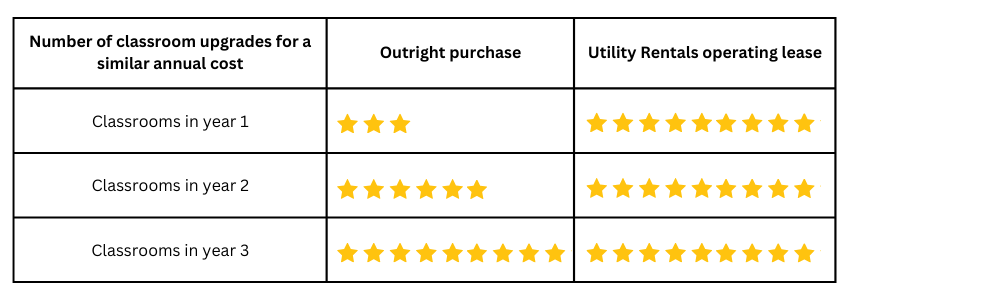
Significantly more, in many cases. Because lease payments are spread over the useful life of the equipment rather than paid upfront, schools often find they can afford several times more equipment than a straight capital purchase would allow. For example, a school with nine classrooms but the capital budget for only three interactive screens a year could, through leasing, equip every classroom with a new screen straightaway rather than replacing screens gradually over several years.
 Why does device consistency matter, and how does leasing help?
When a school buys equipment in phases, it often ends up with a mix of makes, models and ages of device across different classrooms, which makes IT management, maintenance and software compatibility harder. Leasing lets a school equip every classroom with the same model at the same time, and refresh the entire fleet together at the end of the lease, avoiding the mismatched technology that builds up under a buy-as-you-can-afford approach.
What does it mean to lease EdTech through a subscription model?
Leasing EdTech through a subscription model means a school gets brand new equipment – laptops, tablets, interactive screens or similar – without paying the full cost upfront. Instead of one large capital outlay, the school makes regular, budgeted payments over an agreed term, typically two to five years depending on the equipment. It works much like a phone contract: the school uses the device throughout the term and can usually upgrade to the latest models when the agreement ends.
What's the difference between an operating lease and a finance lease?
An operating lease is similar to renting a house: a school pays regular amounts to use the equipment, then returns it (or upgrades) at the end of the term without ever owning it. This suits equipment with a short useful life, such as laptops, tablets and interactive displays. A finance lease works more like a mortgage: the school makes regular payments over an agreed period, and ownership can transfer at the end. Finance leases tend to suit longer-life assets rather than fast-moving technology, which is why most schools leasing laptops or classroom screens choose an operating lease.
What happens if a leased device breaks down or becomes obsolete during the contract?
Leased equipment is typically backed by a maintenance and support agreement with the supplier, so schools are covered for repairs and technical issues throughout the contract term. In fact, this is a strict part of our selection criteria for suppliers: they’ve got to have an established track record and an ability to commit to a multi-year support contract.
This removes one of the biggest risks of buying equipment outright: owned devices that fall out of manufacturer support – as happened when Windows 10 support ended – can become a security risk, whereas leased equipment is refreshed before it reaches that point.
What happens at the end of an EdTech lease?
With an operating lease, the school simply returns the equipment at the end of the term and, if it chooses, upgrades to the latest models – much like renewing a phone contract. There’s no obligation to keep using outdated devices, and no disposal responsibility, because that sits with the finance provider rather than the school.
Leasing compliance and approval
What does IFRS-compliant leasing mean, and will it count as capital or revenue spend?
IFRS-compliant leasing refers to lease agreements structured in line with the international accounting standard IFRS 16, which governs how leases are classified and reported. For schools, the practical effect is that qualifying operating leases are treated as revenue expenditure rather than capital expenditure. That matters because schools typically have far more flexibility in their revenue budgets than in their capital budgets, which are usually reserved for buildings and infrastructure – so IFRS-compliant leasing lets schools fund technology refreshes without needing separate capital sign-off.
Do schools need Department for Education or Secretary of State approval to lease IT equipment?
In most cases, no. Department for Education guidance has expanded what schools can finance through leasing without needing individual Secretary of State approval, including IT equipment and furniture. Because we are an approved provider on the Everything ICT procurement framework, a school can typically move from a supplier’s quote to a signed leasing agreement in days rather than months, without a lengthy separate approval or tendering process.
What is the Everything ICT framework?
The Everything ICT framework is a pre-tendered public sector procurement framework, run by Everything ICT, that has already been through a full competitive tendering process in line with UK procurement regulations. It lets eligible public sector bodies – including UK schools, academies and multi-academy trusts – buy compliant ICT products and services, including leasing, without running their own tender or gathering multiple competing quotes. As an approved leasing provider on the Everything ICT framework, we give schools a route to technology finance that already satisfies public sector procurement rules.
Are academies and multi-academy trusts (MATs) automatically eligible to lease EdTech?
Yes. UK state schools and academies are pre-approved for funding through approved providers on the Everything ICT procurement framework. This means academies and multi-academy trusts can lease laptops, tablets and other technology without a separate credit application or lengthy approval process, in the same way as other state-funded schools.
Does leasing EdTech help schools meet GDPR and cyber security requirements?
Yes, indirectly but meaningfully. Because leased equipment is refreshed on a regular cycle, schools are less likely to be running devices that have fallen out of manufacturer security support – a common source of vulnerabilities that can put staff, pupil and parent data at risk. Keeping hardware current in this way makes it easier for schools to stay aligned with GDPR requirements and safeguard sensitive information.
Utility Rentals and ClaaS: direct leasing providers
What is Classroom as a Service (ClaaS)?
Classroom as a Service (ClaaS) is a subscription finance provider for schools, backed by Utility Rentals, a company with over 40 years’ experience in the leasing sector. ClaaS turns a supplier’s one-off quote for laptops, tablets, interactive screens or other technology into an affordable lease: instead of paying the full cost upfront, a school spreads the cost over regular, budgeted payments, while ClaaS pays the supplier directly and owns the equipment for the length of the agreement.
What equipment can schools lease through ClaaS?
Schools can lease almost any technology a supplier can provide a quote for, including laptops, PCs, Macs, iPads and tablets, interactive screens, digital signage, and VR headsets. If it’s technology a school needs and a supplier can quote for it, there’s a good chance it can be financed through a subscription model rather than an outright purchase.
How quickly can a school get a leasing proposal after a supplier's quote?
Once a supplier has issued a quote, it can be turned into a fully costed leasing proposal in as little as 30 seconds using ClaaS’s online quoting tool. The proposal is emailed to the school along with a simple, one-page response form, so the school can accept the offer without complex paperwork or a lengthy back-and-forth.
What's the difference between leasing through a direct funder and a broker?
A broker shops a school’s deal around multiple lenders, which can add time, extra fees, and a longer chain of communication between the school, the broker, the supplier and whoever eventually funds the deal. ClaaS is a direct funder: it uses its own capital, backed by Utility Rentals’ 40 years in the leasing sector, and makes lending decisions itself. That removes broker commission from the rate, speeds up decisions, and gives the school a single point of contact rather than several intermediaries.
How does a school get started leasing EdTech?
Leasing won't be the right answer for every purchase – some equipment still makes sense to buy outright. But for laptops, tablets and other fast-moving technology, it's increasingly the more affordable and lower-risk option. If a school is already talking to an EdTech supplier about new equipment, it's worth asking whether they can offer it through Classroom as a Service (ClaaS). If the supplier isn't yet familiar with ClaaS, schools can point them to classroomasaservice.co.uk/suppliers, or get in touch and we'll happily talk it through directly.
Ready to simplify your school's leasing?
We've been helping UK schools lease equipment since 1985. Let's talk.